


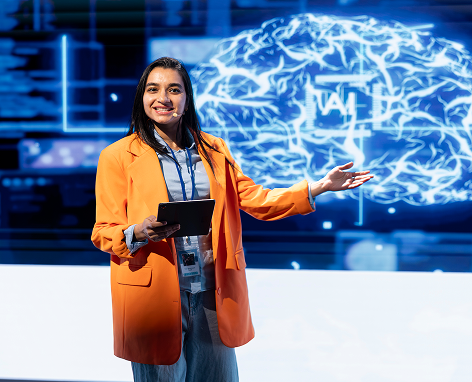
In the quiet hum of servers and the swirl of algorithms, a revolution quietly unfolded upon the world. It is the AI revolution; vast, unstoppable, and already reshaping the architecture of our future. And somewhere in the mix, almost unnoticed at first, another uprising began to take form: the rise of women in AI.
Not loud, not flashy but steady, strategic and transformative.
Women in AI who were once pushed to the margins of technology are now stepping into roles that shape the very foundations of tomorrow. They are building infrastructures, designing systems, questioning assumptions, and rewriting the rules of innovation. They are entering labs, leading research teams, founding startups, and influencing global AI policy often without fanfare, but always with impact.
And as I write this, I am doing my part too, learning more about AI every single day, exploring how it works, how it thinks, and how I can use it to build, create, and empower. I am studying its language, testing its tools, and discovering ways it can amplify women’s voices, ideas, and leadership. I am not just observing the revolution; I am participating in it, step by step, skill by skill, insight by insight.
This is the moment the world begins to recognize what has been quietly true all along:
women in AI are not just joining the revolution and they are redefining it.
Women are rising in AI, but the numbers still reveal a landscape shaped by imbalance and opportunity.
Globally, women hold only 22–30% of AI roles, depending on the study.
Representation drops sharply at senior levels, in leadership, research labs, and executive decision-making. Women of color remain the most underrepresented group in the entire AI ecosystem.
Women are also 20–25% less likely to adopt generative AI tools, often due to limited exposure, confidence gaps, or lack of targeted learning pathways. Attrition remains high in male-dominated tech environments, where bias, microaggressions, and unequal recognition persist.
Yet the trajectory is shifting. More women are entering AI through interdisciplinary paths psychology, linguistics, healthcare, ethics, law, and the creative arts. The field is expanding, and women are stepping into it with fresh perspectives and a hunger to shape the future.
Why does this matter? Because AI is not just technology. It is power. It is policy. It is culture. It is the invisible architecture behind healthcare, education, policing, hiring, creativity, and global decision-making. Without women at the table, AI risks becoming a mirror of old inequalities rather than a tool for new possibilities.
Women bring a depth of insight that AI desperately needs not as a courtesy, but as a corrective force.
They bring emotional intelligence, ethical foresight, and interdisciplinary thinking. They bring lived experiences that broaden the lens of innovation. They bring leadership styles rooted in collaboration, community, and long-term impact.
They’re intuitive, able to sense what’s missing long before the data reveals it.
This is why women like Joy Buolamwini, Timnit Gebru, Fei-Fei Li, Rana elKaliouby, Deborah Raji, and Anja Kaspersen have reshaped the field. They exposed algorithmic bias, championed ethical AI, expanded access to AI education, and built technologies that honor humanity rather than exploit it.
Women don’t just diversify the room they transform the conversation. They design with empathy and nuance. They build systems that reflect the full spectrum of human experience.
And in a world where AI is becoming the backbone of society, this is not optional. It is essential.
Women face a complex web of barriers: early stereotypes that push girls away from STEM, workplace bias that forces women to “prove it again,” a lack of visible role models, limited mentorship, and the invisible labor of caregiving that often goes unrecognized.
Women founders receive less funding. Women researchers receive less credit. Women engineers face more scrutiny. Women leaders face more resistance.
But these barriers are not immovable. They are being challenged every day by women who refuse to shrink, who refuse to wait for permission, who refuse to let the future be built without them.
The solution is not just policy; it is presence, involvement, visibility and community. It is women stepping into AI from every corner of life and declaring, “I belong here.”
Women have always been at the forefront of computing from Ada Lovelace, the world’s first programmer, to Grace Hopper, who built the first compiler. Today, a new generation is carrying the torch.
Joy Buolamwini exposed racial and gender bias in facial recognition and founded the Algorithmic Justice League.
Timnit Gebru challenged the ethics of large language models and co-founded Black in AI.
Fei-Fei Li pioneered computer vision and created AI4ALL to expand access to AI education.
Rana el Kaliouby built emotion AI and championed human-centered machine intelligence.
Deborah Raji pushed for accountability in AI systems used by governments and corporations.
Anja Kaspersen shaped global AI governance and advocated for women’s inclusion in policy.
Their stories remind us that women are not just participating in AI they are shaping its moral compass. And yes, your name and mine belong in that lineage too women learning, building, questioning, and contributing to the future of intelligence.
The beautiful truth about the AI revolution is this: it does not demand perfection, pedigree, or a polished résumé. It simply asks for curiosity. It asks for courage. It asks for women who are willing to whisper or declare “I belong in this future too.”
And no matter where you stand today, you can enter AI.
If you’re a stay-at-home mum, you already run one of the most complex systems on earth. You manage schedules, emotions, logistics, negotiations, and crisis-response all the things AI is trying to learn. You can begin by exploring AI tools that support planning, creativity, budgeting, or education. Your lived experience is not a limitation; it is insight. It is valuable. AI needs women who understand the rhythms of real life.
If you’re a medical professional, you already work where humanity meets data the heart of AI. You understand patterns in symptoms, patient behavior, and care systems. You can explore medical AI tools, learn how algorithms support diagnosis, or contribute to projects that improve maternal health, chronic care, or mental health support. Your empathy and precision are superpowers in AI.
If you’re a researcher or academic, your ability to question, test, and analyze is the foundation of machine learning. Whether your field is psychology, sociology, linguistics, biology, or economics, your expertise is deeply relevant. AI is not just technical, it is philosophical, cultural, and human. Your mind belongs to the room where the future is being shaped.
If you’re a creative, writer, or storyteller, AI is hungry for imagination. For metaphor. For narrative. For the human touch. You can train models in your writing style, build storytelling tools, or shape how AI understands emotion and identity. Your creativity is not separate from AI; it is the soul of it.
If you’re an entrepreneur or visionary, AI is the greatest business partner you will ever have. It can help you test ideas, build prototypes, analyze markets, and scale faster than ever. Your ambition is fuel. AI is the engine.
No matter your background, the path into AI begins the same way: You embrace it. You learn it. You become part of the revolution.
Organizations must do more than hire women they must build environments where women can thrive. That means measurable diversity goals, inclusive culture design, flexible work policies, mentorship and sponsorship programs, transparent promotion criteria, and funding for women-led AI ventures.
The future of AI depends on the structures we build today.
Women are poised to lead in ethical AI, AI governance, AI for social good, healthcare AI, climate AI, and interdisciplinary innovation. Intersectionality must be at the center of this future ensuring that women from underrepresented groups are not left behind.
The compounding effect is powerful:
More women → more role models → more inclusion → better AI systems.
This is how transformation happens.
Let this be your invocation:
You are not a guest in the house of technology; you are the architect.
You are not a footnote in the story of innovation; you are the author.
You are not a shadow in the age of machines. You are the light.
Step into the lab; Step onto the stage; Step into your power.
The revolution needs your rhythm; The algorithms need your ethics. The future needs your fire.
Final Thoughts
Women in AI are not just participants.
They are game changers, visionaries, and architects of a more humane future.
Whether you are entering AI for the first time or rising into leadership, your voice matters. Your presence matters. Your perspective matters.
Share this story, Mentor a woman; Advocate for inclusion.
Champion the next wave of women in AI. The future is unfolding and women belong at the center of it.